Quick answer
Buyers get more reliable UV printed acrylic retail displays when they brief the product application, finished dimensions, material finish, viewing side, print layers, load, packing route and approval evidence together. A visually attractive render is not a production specification: the supplier needs a controlled drawing and a production-intent sample to confirm print opacity, product fit, stability and delivery readiness.
This guide is written for buyers who need a usable decision record before requesting a quote, approving a sample or releasing a custom acrylic order for production. It focuses on the details that repeatedly affect feasibility, repeatability and receiving quality in B2B programmes.
Start with the retail decision, not the artwork file
A custom acrylic point of sale display should be briefed as a retail tool before it is briefed as a printed object. Tell the supplier what product will sit in the display, how many units must be visible, where the display will stand, who replenishes it, and how shoppers are expected to approach it. Provide the actual product dimensions and weight, including any cap, hanger, carton or tamper seal that changes the envelope. A compact counter stand that holds lightweight cosmetics has a different construction from a shelf tray carrying glass bottles, even when the visible printed panel is similar. Note the available counter footprint, the maximum display height, nearby fixtures, lighting and whether customers may touch the display. These details let the factory review load paths, sightlines and access openings instead of choosing thickness from a generic chart. A useful brief also separates essential requirements from preferences: product capacity and stable standing are functional requirements, while a tinted edge or layered logo may be a visual preference. That distinction helps the buyer compare quotation options without losing the job the display must do.
Turn the requirement into an approval record
For a B2B order, turn this point into a written part of the brief: name the decision owner, the evidence needed for approval and the condition that would require a revision. This prevents a commercial requirement from being lost between a visual reference, a supplier quotation and a production instruction. It also gives the factory a practical reference during factory testing instead of relying on an informal interpretation after production has started.
Validate the decision in actual use
During sample review, test this decision in the product application rather than in isolation. the actual product fit, printed viewing face, white-ink opacity, loaded stability, assembly sequence, visible surface quality and packed-store receiving experience should be reviewed with the approved artwork, material and packing assumptions in view. Record the result with photographs and a dated approval note, then carry the same checkpoints into in-process inspection and shipment preparation.
Specify acrylic material, thickness and visible surfaces
For acrylic display UV printing, identify the sheet appearance and construction before approving colour. Clear acrylic can make an object feel light and premium, but it can also reveal adhesive lines, fingerprints or interior components if the build is not planned carefully. Frosted, coloured or mirror components can create contrast, yet each finish has its own surface-protection and print-coverage considerations. State which face is customer-facing, whether polished edges are visible, and whether protective film should remain on a surface until store installation. Describe the finished size, nominal thickness, bends, shelves, dividers, holes, slots, standoffs and assembly points. Where a shelf carries stock, share the expected loaded weight and unsupported span; where a tall sign panel is used, share the base dimensions and handling scenario. A supplier can then recommend a construction, but the buyer should ask for that recommendation to be shown on the drawing rather than only mentioned in an email. If the display is shipped in parts, assign a code to every panel and hardware bag. This material map makes it much easier to inspect the correct sheet finish, print side and component count during factory testing and at receiving.
Turn the requirement into an approval record
For a B2B order, turn this point into a written part of the brief: name the decision owner, the evidence needed for approval and the condition that would require a revision. This prevents a commercial requirement from being lost between a visual reference, a supplier quotation and a production instruction. It also gives the factory a practical reference during factory testing instead of relying on an informal interpretation after production has started.
Validate the decision in actual use
During sample review, test this decision in the product application rather than in isolation. the actual product fit, printed viewing face, white-ink opacity, loaded stability, assembly sequence, visible surface quality and packed-store receiving experience should be reviewed with the approved artwork, material and packing assumptions in view. Record the result with photographs and a dated approval note, then carry the same checkpoints into in-process inspection and shipment preparation.
Plan UV artwork, white ink and viewing direction
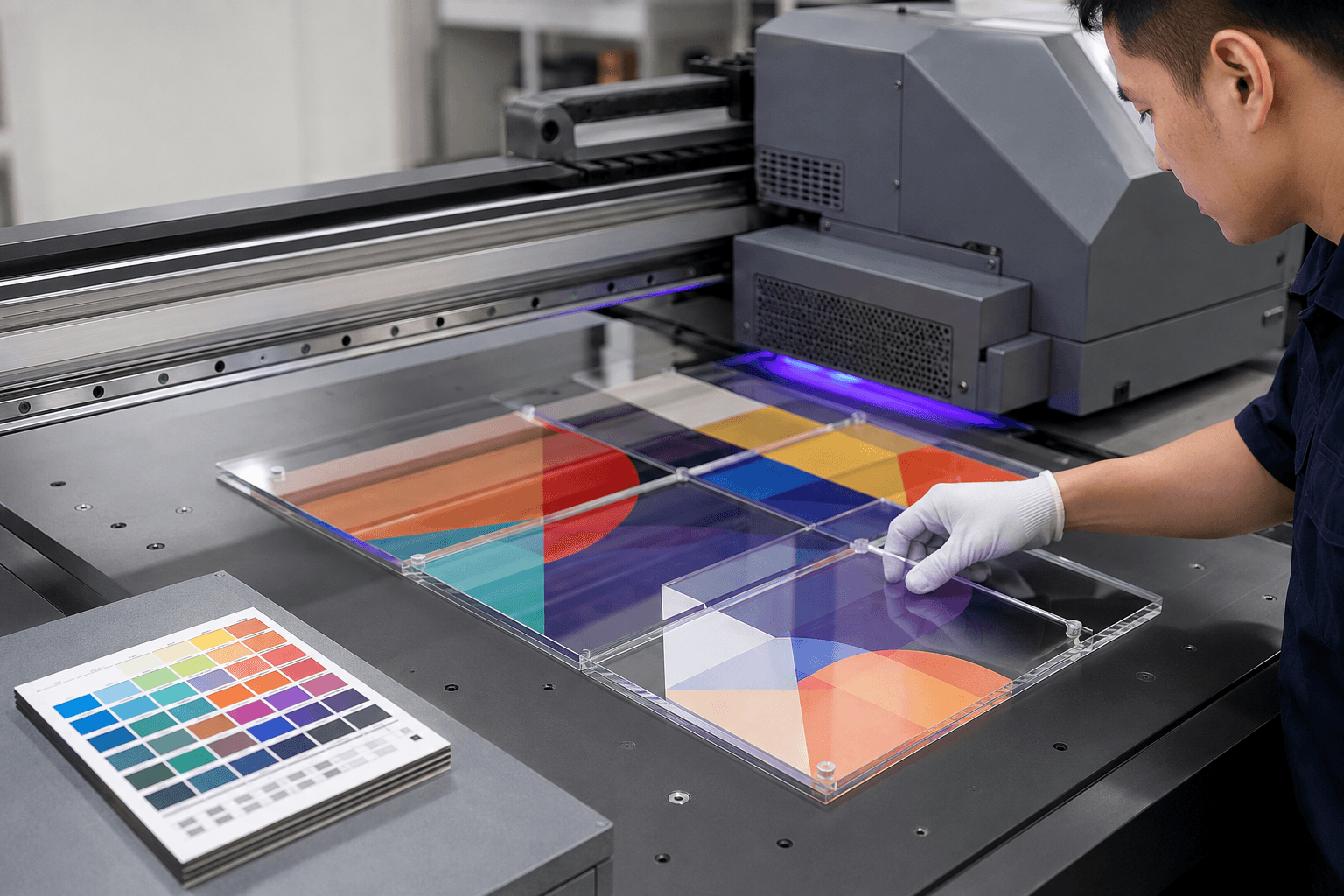
UV printing can reproduce detailed colour graphics on acrylic, but the file must explain how the graphics will be viewed through or on the sheet. A CMYK image printed behind clear acrylic may look weak or change colour without a white backing layer; a graphic printed on the front face can be more exposed to abrasion during handling. Ask the supplier for a proof that separates cut lines, CMYK artwork, spot white, varnish if used, and any back-print or double-sided layers. Do not rely on a flattened preview when white ink or transparency matters. For logos, vector AI, PDF, EPS or SVG files are normally the clearest starting point; for photographic images, send a high-resolution original at final-use scale. Mark safe zones around drill holes, slots and outside edges so important text is not lost after cutting. If a display has two customer-facing sides, explain whether both must read correctly through the acrylic or whether one side is intended for staff. Brand colour should be approved using a physical production-intent sample under representative retail lighting, because a digital screen and a clear panel on a factory bench cannot fully predict the installed result.
Turn the requirement into an approval record
For a B2B order, turn this point into a written part of the brief: name the decision owner, the evidence needed for approval and the condition that would require a revision. This prevents a commercial requirement from being lost between a visual reference, a supplier quotation and a production instruction. It also gives the factory a practical reference during factory testing instead of relying on an informal interpretation after production has started.
Validate the decision in actual use
During sample review, test this decision in the product application rather than in isolation. the actual product fit, printed viewing face, white-ink opacity, loaded stability, assembly sequence, visible surface quality and packed-store receiving experience should be reviewed with the approved artwork, material and packing assumptions in view. Record the result with photographs and a dated approval note, then carry the same checkpoints into in-process inspection and shipment preparation.
Build a representative sample before releasing bulk production
A retail display sample is a decision tool, not a decorative pre-production gift. The most useful sample uses the intended acrylic family, finished thickness, print process, edge finish, assembly method and a packed configuration close to the planned order. Test it with actual sellable products or controlled weight substitutes. Place it on the expected counter or shelf and check whether labels remain visible, whether products can be picked up without catching, whether staff can replenish quickly, and whether the loaded unit feels stable. Review the printed panel at the normal shopper distance as well as close up. A surface that looks perfect in a studio can show glare, dust or insufficient opacity under spotlights. Record the approved sample with dated photos of the front, rear, edges, product-loaded view and packed set. The approval note should name the artwork revision, material and thickness, final dimensions, allowable visual marks, pack-out sequence and any installation preparation. For multi-market or multi-SKU programmes, attach a simple variation matrix so a local language panel or product-size change does not accidentally use an outdated component.
Turn the requirement into an approval record
For a B2B order, turn this point into a written part of the brief: name the decision owner, the evidence needed for approval and the condition that would require a revision. This prevents a commercial requirement from being lost between a visual reference, a supplier quotation and a production instruction. It also gives the factory a practical reference during factory testing instead of relying on an informal interpretation after production has started.
Validate the decision in actual use
During sample review, test this decision in the product application rather than in isolation. the actual product fit, printed viewing face, white-ink opacity, loaded stability, assembly sequence, visible surface quality and packed-store receiving experience should be reviewed with the approved artwork, material and packing assumptions in view. Record the result with photographs and a dated approval note, then carry the same checkpoints into in-process inspection and shipment preparation.
Turn customer requirements into factory testing checkpoints
Factory testing is more useful when it mirrors how the display will be used. Before production starts, give the factory a concise inspection checklist based on the approved sample and drawing: verify cut size and critical hole positions; check print registration, white-ink coverage and legibility; inspect visible clear faces after protective film removal; confirm polish, bonding and assembly alignment; load the fixture with the agreed product weight; and verify each hardware and packaging component. The checklist should identify what is measured, what is visually compared and who gives approval if a deviation appears. For a display with interchangeable inserts, test that the insert can be changed without scratching the panel or loosening a fit. For flat-packed pieces, complete one full assembly with the supplied hardware and instructions. During shipment inspection, open selected cartons rather than reviewing only loose displays. Confirm that parts cannot rub against printed or polished surfaces, that carton labels match the destination or SKU logic, and that a receiving team can identify every component. Photographs are helpful evidence, but the written checklist gives them a practical context.
Turn the requirement into an approval record
For a B2B order, turn this point into a written part of the brief: name the decision owner, the evidence needed for approval and the condition that would require a revision. This prevents a commercial requirement from being lost between a visual reference, a supplier quotation and a production instruction. It also gives the factory a practical reference during factory testing instead of relying on an informal interpretation after production has started.
Validate the decision in actual use
During sample review, test this decision in the product application rather than in isolation. the actual product fit, printed viewing face, white-ink opacity, loaded stability, assembly sequence, visible surface quality and packed-store receiving experience should be reviewed with the approved artwork, material and packing assumptions in view. Record the result with photographs and a dated approval note, then carry the same checkpoints into in-process inspection and shipment preparation.
Protect the display through packing, freight and store receiving
Packing decisions should be made while the display is being designed, especially when transparent faces, polished edges or printed panels create a high surface-risk product. Use clean protective film, soft interleaving, edge guards and controlled component bags where appropriate, but test the system on a finished packed set. Metal fasteners and loose acrylic panels should never be able to move against each other in a carton. A layered display may need component labels and an assembly sequence so store teams do not remove film too early or fit a printed panel in the wrong orientation. For global shipments, include the destination, delivery term, carton limits and required retail-ready labelling in the RFQ. A low freight volume is valuable only if the display can be assembled safely and consistently at the other end. If the display is destined for a store rollout, test the first carton as a receiving exercise: can a staff member identify the fixture, unload it without scratching a face, find the instructions, assemble it and place product within a reasonable workflow? That trial often identifies problems no render or unit-price comparison will expose.
Turn the requirement into an approval record
For a B2B order, turn this point into a written part of the brief: name the decision owner, the evidence needed for approval and the condition that would require a revision. This prevents a commercial requirement from being lost between a visual reference, a supplier quotation and a production instruction. It also gives the factory a practical reference during factory testing instead of relying on an informal interpretation after production has started.
Validate the decision in actual use
During sample review, test this decision in the product application rather than in isolation. the actual product fit, printed viewing face, white-ink opacity, loaded stability, assembly sequence, visible surface quality and packed-store receiving experience should be reviewed with the approved artwork, material and packing assumptions in view. Record the result with photographs and a dated approval note, then carry the same checkpoints into in-process inspection and shipment preparation.
Compare supplier quotations as complete production proposals
When sourcing UV printed acrylic retail displays, ask suppliers to quote against one controlled brief and break down the variables that affect the finished result. The response should identify proposed material and thickness, cutting and finishing, print method and layers, white ink or back-printing, assembly, sample terms, inspection evidence, packing, carton dimensions, delivery term and lead-time assumptions. Ask open questions to be stated rather than silently assumed. This prevents buyers from comparing one supplier's flat-packed loose panels with another supplier's assembled, retail-ready fixture as if the unit prices describe the same offer. Review the supplier's drawing and sample plan as carefully as the price. A credible factory should be able to explain how it will protect visible surfaces, what it will test before shipment and what evidence it can share for the buyer's approval record. For repeat orders, retain the signed drawing, artwork revision, sample photos, material references, carton record and inspection checklist. Those records turn a successful first rollout into a repeatable custom acrylic programme instead of a new sourcing exercise every time.
Turn the requirement into an approval record
For a B2B order, turn this point into a written part of the brief: name the decision owner, the evidence needed for approval and the condition that would require a revision. This prevents a commercial requirement from being lost between a visual reference, a supplier quotation and a production instruction. It also gives the factory a practical reference during factory testing instead of relying on an informal interpretation after production has started.
Validate the decision in actual use
During sample review, test this decision in the product application rather than in isolation. the actual product fit, printed viewing face, white-ink opacity, loaded stability, assembly sequence, visible surface quality and packed-store receiving experience should be reviewed with the approved artwork, material and packing assumptions in view. Record the result with photographs and a dated approval note, then carry the same checkpoints into in-process inspection and shipment preparation.
Buyer checklist before approval
A short written checklist helps a procurement team confirm that the production decision is complete before a project moves into volume manufacturing. Review the points below with the supplier and attach the final version to the approval record.
- Application, product dimensions, loaded weight and retail footprint documented
- Material map identifies sheet finish, thickness, visible face and component codes
- Artwork proof separates cut lines, CMYK, white ink and any double-sided layers
- Production-intent sample approved with actual products under representative lighting
- Factory testing includes print registration, assembly, product fit and loaded stability
- Shipment inspection checks a complete packed set, labels and receiving sequence
These checks are not intended to replace a project-specific specification. They provide a practical handover between the buyer, artwork owner, factory team and logistics contact so each party knows which requirement has already been approved and which still needs an answer.
Production and delivery checks
Production planning should begin with a controlled handover: the approved artwork or drawing, material and finish, sample photographs, packing instruction and named inspection points. In-process factory testing is most useful when it checks the risks that affect the final product in use, not only a random finished unit. If the product has an assembly, a product-fit condition, a variable-data field or an installation component, include that condition in the written inspection plan.
Before dispatch, shipment inspection should look at the product and the complete packed set. Open selected cartons, check the protective materials, count components, compare carton labels with the required destination logic and photograph the prepared set. This evidence gives the receiving team a clearer reference and makes repeat orders easier to manage.
Conclusion
A practical brief, a documented sample and a defined inspection plan give a custom acrylic project a stronger basis for cost, quality and delivery decisions. Share the details that affect the product in use, then keep the approved record available for future orders and programme updates.