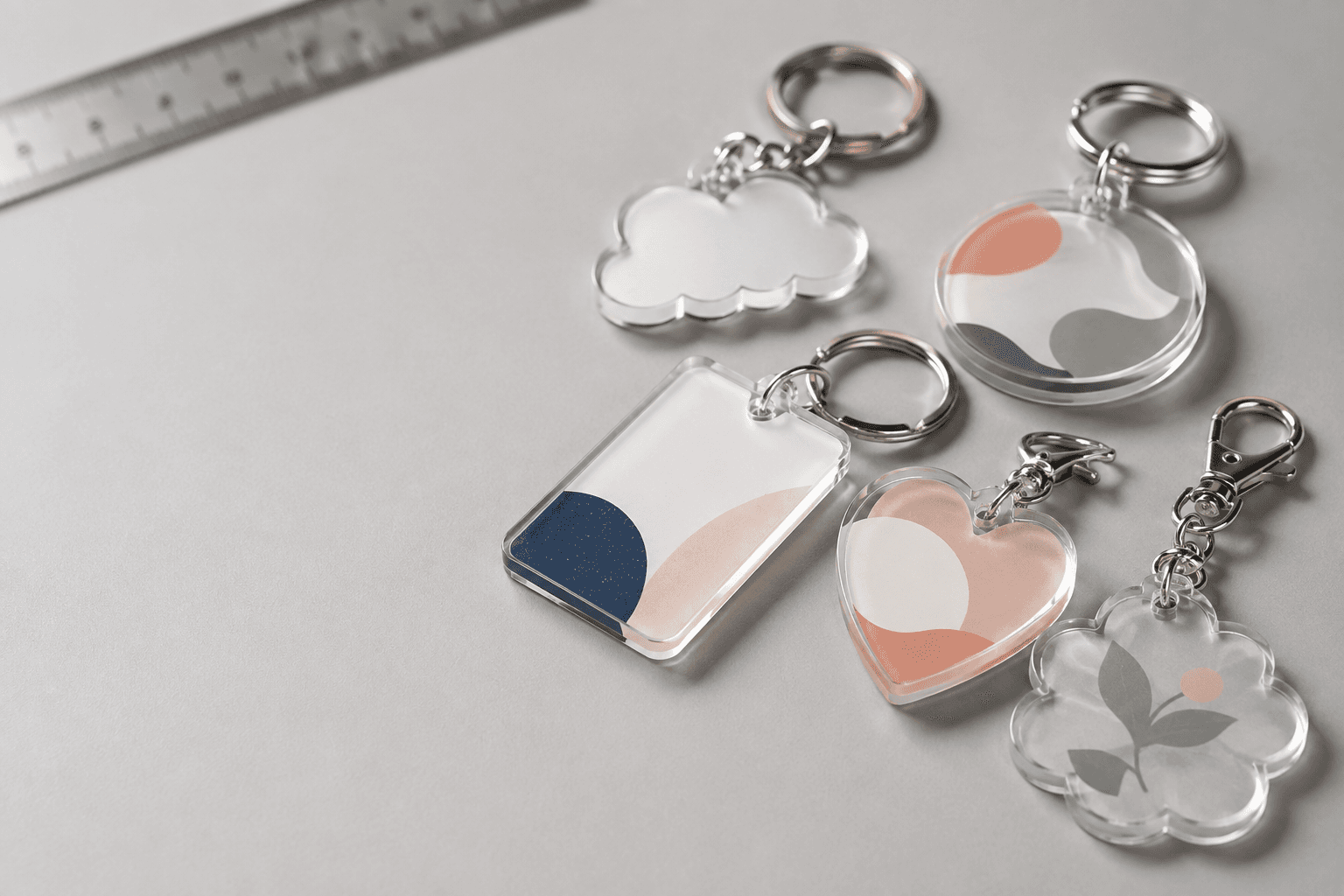
Custom acrylic keychains look simple because the finished product is small. In practice, a reliable bulk order depends on several linked choices: how the artwork is prepared, what type of acrylic is used, whether the print is single- or double-sided, how the shape is cut, which attachment is fitted, and how the pieces are packed for delivery.
For a retail collection, event giveaway or promotional programme, the most successful keychains are designed as products rather than as miniature posters. The artwork remains readable at the finished size, the attachment suits the intended use, and the factory has enough information to test a sample before production starts.
This guide walks through the decisions a B2B buyer should make before requesting a quote.
Quick answer: what does a factory need to quote custom acrylic keychains?
To quote accurately, a supplier normally needs the artwork or a clear visual reference, finished size, quantity per design, print sides, acrylic type or desired effect, attachment choice, packaging request, delivery market and required date. If any point is undecided, say so. A good supplier can identify the decisions that affect feasibility, price and lead time rather than guessing.
Define the job the keychain needs to do
The first question is not “What looks cute?” It is “How will this item be used?” A keychain for a branded event bag may need broad appeal, simple packaging and a robust ring. A retail charm collection may need several designs, collectible finishes and a display-ready backing card. An employee-gift order may prioritise a more restrained logo treatment and individual packaging.
Write a short product brief before design begins:
- Audience: customers, event attendees, retail shoppers, staff, creators or partners.
- Use case: giveaway, sell-through retail product, membership item, packaging insert or internal gift.
- Quantity: total units and units per artwork design.
- Target size: approximate width and height, not only a vague “small” or “large.”
- Brand priority: logo visibility, illustration quality, photo reproduction, text legibility or collectability.
- Delivery plan: bulk cartons, individual bags, backing cards, boxed sets or multiple ship-to locations.
This brief makes later production decisions easier to explain and approve.
Choose the shape before adding decorative effects
Standard rectangles, circles and ovals are efficient, but a custom contour shape can make an event character, logo or product outline much more memorable. A custom outline should follow the strongest silhouette in the artwork, not every tiny detail. Fine points, narrow bridges and enclosed gaps may be difficult to cut cleanly or may be vulnerable in use.
In a factory-ready artwork review, the design team should check the contour line separately from the printed image. The contour needs to be clear, smooth and offset enough from important visual details. If a logo has thin strokes or small detached elements, a plaque-style shape may produce a better finished keychain than an exact outline.
A practical size rule
Pick a size based on use, not a catalogue default. A smaller charm works for a subtle bag accessory; a larger piece offers more room for character art or event messaging. At any size, allow a safe margin from the edge to the printed artwork and make sure the hole or attachment point does not compete with a face, logo or important line of text.
Select the acrylic and decoration method
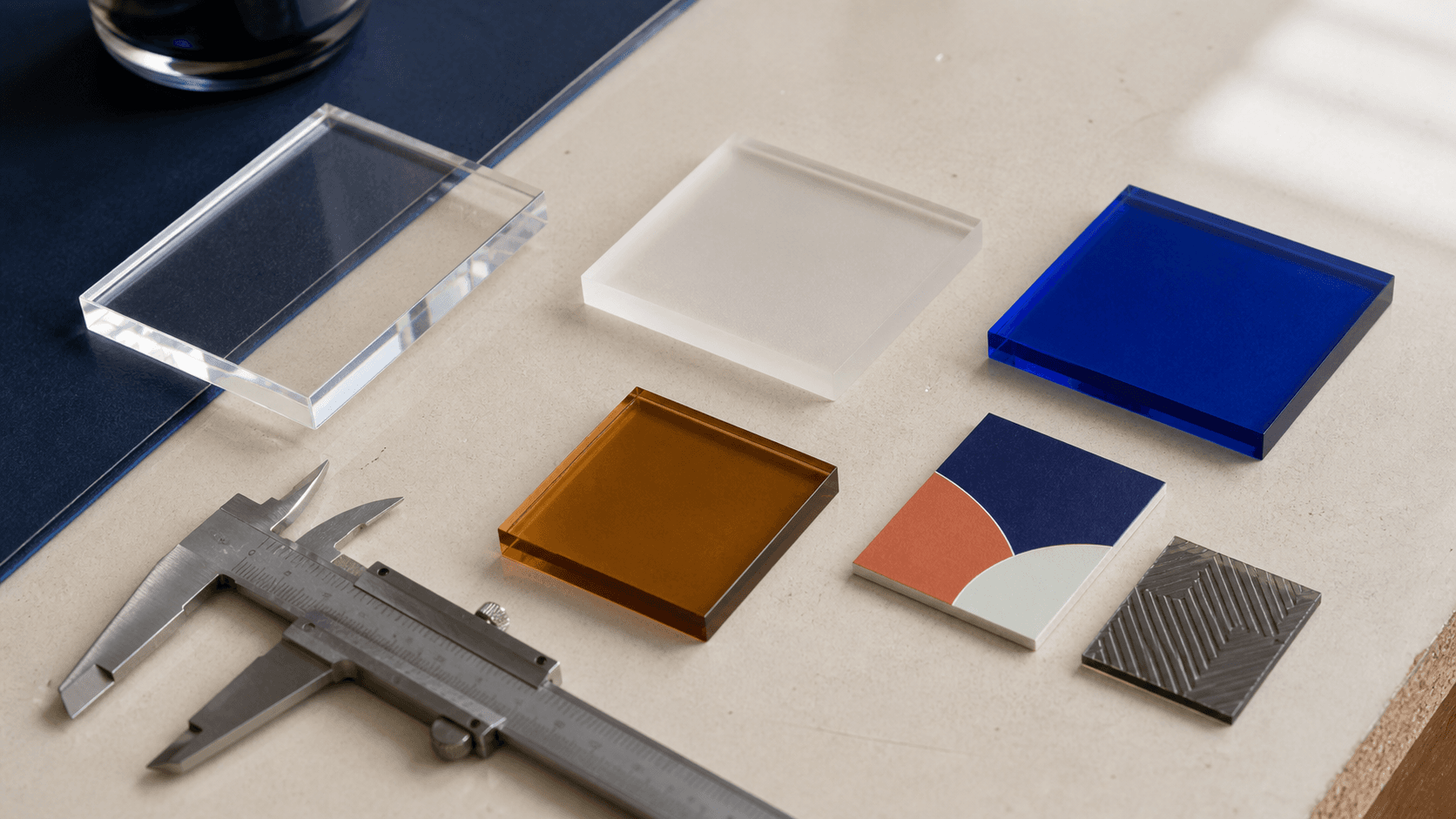
Clear acrylic is the most versatile base because it can create a clean, glass-like edge around full-colour artwork. Other effects—frosted, glitter, translucent colour, mirror or holographic material—can add personality, but they should reinforce the design instead of making it harder to read.
| Option | Best used for | Buyer check before approval |
|---|---|---|
| Clear acrylic | Logos, illustrations, photo-like colour, universal events | Confirm if a white backing layer is needed for opacity |
| Frosted acrylic | Softer, premium or understated designs | Check contrast of small type and pale artwork |
| Glitter or patterned acrylic | Collectible, seasonal or youth-focused retail | Request a sample because the material itself changes colour perception |
| Translucent colour | Campaigns with strong brand colour | Test whether the artwork remains legible against the coloured base |
| Double-layer construction | Premium designs needing depth or a dark backing | Check edge visibility, alignment and assembly tolerance |
For full-colour designs, UV printing is commonly used because it can reproduce graphic detail on a flat acrylic surface. The crucial question is not only “Can you print this?” but “Which side will be viewed, and how will the layers read through the material?” A proof should identify front and back, white ink or backing layers, any mirrored artwork, cut line and hole position.
Prepare artwork that survives the real finished size
Artwork that looks clean on a laptop can become crowded on a small product. Good production preparation starts with the final physical dimensions. Avoid relying on hairline strokes, long paragraphs, low-contrast text and miniature QR codes unless a physical test confirms they are readable.
Provide editable vector artwork when possible, such as AI, PDF, EPS or SVG, alongside linked fonts or outlined text. High-resolution raster files can work for photographic images, but they should be large enough for the intended print dimensions. A supplier may request a PDF proof even when the original is vector, because the proof establishes the visible version that will be approved.
Before you sign off, confirm:
1. The exact design count and quantity for each design. 2. Finished width and height, including any ring or chain that affects packaging. 3. Print side(s) and viewing orientation. 4. Hole, chain, split-ring, clasp or carabiner position. 5. White backing and transparent areas. 6. Backing-card, bag or label requirements.
Choose an attachment that fits the use case
The attachment is not an afterthought. A split ring is familiar and robust for conventional keys. A ball chain can be practical for event passes or lightweight charms. A lobster clasp can suit bags and fashion accessories. A phone strap or silicone loop may be more relevant for a youth-oriented campaign.
Ask the supplier to show the attachment in the sample photo, not only as a catalogue name. Check finish colour, opening action, connection point and whether the hardware can scratch the acrylic during packing. If the order includes several designs, decide whether every design uses the same hardware; standardising can make assembly and inspection easier.
Treat the sample as a test, not a souvenir
A pre-production sample should answer the questions that cannot be settled in a digital mock-up. Does the clear edge look clean? Does a gradient stay vivid? Is the white backing even? Does the attachment sit in the intended direction? Does the backing card protect the item without hiding the design?
For a promotional order, ask for a simple sample-review sheet. It can list the approved file version, key dimensions, print side, material, hardware, packaging and visible quality criteria. This gives both buyer and supplier a shared reference when production starts.
During production, useful factory checks include looking for surface scratches, edge marks, print registration issues, incomplete holes, loose hardware and mixed artwork versions. Before shipment, carton labels, inner quantities and protective packing should be checked against the order plan. These are ordinary controls, but stating them early makes them easier to manage.
Understand MOQ, samples and quotation scope
Minimum order quantity is not one universal number. It can change with the design count, acrylic type, attachment, individual packaging and whether multiple small variants are combined in one order. Rather than asking only “What is your MOQ?”, ask: What is the minimum per design, and what changes if I use three artwork variations, special material or retail packaging?
Request a quote that separates the important variables. A transparent quotation should identify the per-design quantity, finished size, material, printing method, number of print sides, hardware, packaging, sample arrangement, production lead-time assumption and shipping terms. This makes it much easier to compare two suppliers without overlooking a missing element.
Common ordering mistakes and how to avoid them
Most production issues appear before the factory switches on a machine. They begin with an incomplete brief, a visual reference that is treated as a technical drawing, or a late decision about packaging. Buyers can avoid many of these problems by using a structured approval sequence.
Mistake 1: approving colour from an uncalibrated screen
Brand colour is important, especially for retail or campaign products. Yet a phone or laptop cannot guarantee how a printed colour will appear on a clear, frosted or coloured substrate. If colour accuracy is essential, provide the correct colour reference and request a sample or controlled proof. The final approval should state which material and backing treatment was reviewed because those choices affect perceived colour.
Mistake 2: leaving “back side” undefined
A keychain rotates in use. If the back is left undefined, the product may show a white backing layer, a mirrored image, a plain clear surface or a second print in a way that was never discussed. State whether the back should be clear, white, mirrored, printed, engraved or protected by another acrylic layer. Then confirm it in the proof.
Mistake 3: treating packaging as an optional extra
For a retail-ready item, backing cards and bags are part of the product experience. For a giveaway, bulk packing may be sufficient. For an international shipment, individual protection can reduce surface marks caused by hardware moving against acrylic. Decide the pack-out before the sample stage when possible, and show the attachment and keychain orientation on the packaging proof.
Mistake 4: changing artwork after production preparation has begun
Artwork changes can be manageable early, but they can affect cut paths, print layers, sample records and packing counts. Keep a version-controlled file name, nominate one buyer-side approver and collect revisions into a single instruction. If a change is made after sample approval, ask the supplier to confirm exactly what must be rechecked and whether timing or cost changes.
Mistake 5: asking for “good quality” without defining acceptance criteria
Quality becomes easier to manage when buyers describe what they care about: no visible scratches from the front viewing side, consistent print placement, smooth polished edges, secure attachment hardware, correct artwork version and protective packing. This does not require a complicated inspection manual. A short list attached to the quote or production approval is often enough to make expectations visible.
Build a keychain brief a factory can act on
A clear enquiry prevents a supplier from making assumptions that later become rework. For every design, provide a reference image or artwork file, finished-size range, quantity split, desired acrylic look, print side, attachment type and packing expectation. Add the country or sales channel if the product will be resold, because barcode labels, backing cards, warnings and retail presentation may matter as much as the charm itself.
If the product will be given away at an event, explain the distribution method. A keychain handed out from a booth can be optimised for speed and bulk packing. One sold in a shop needs its front-facing artwork, hole alignment and backing card considered together. One included in a subscription kit may have a strict thickness or weight limit. The same illustration can therefore lead to different technical decisions.
Create an approval record that follows the order
After the buyer approves the sample, compile a short production record rather than relying on a chain of messages. It can contain the approved artwork file name, final dimensions, acrylic finish, print layers, hardware reference, packaging layout, carton count and defined visual checks. This becomes the checklist used by the factory team during production and by the buyer when reviewing shipment photos or a third-party inspection.
For multiple designs, add a simple matrix: design name, quantity, front artwork, back artwork, attachment and pack code. It reduces the risk of a correct charm being packed with the wrong card or label. The goal is not bureaucracy; it is to give both sides a single source of truth when the order moves from quotation to sample, production and shipment.
Plan repeat orders while the first order is fresh
Event and retail buyers often reorder a successful keychain months later, when the original approver may no longer be available. Save the approved proof, sample images, purchase order, material/hardware notes and packing instructions with a version date. If the next run changes only the artwork, identify exactly what remains unchanged. If a new attachment, finish or pack is introduced, treat that part as a new sample question instead of assuming it will behave identically.
Frequently asked questions
What file should I send for custom acrylic keychains?
Vector artwork such as AI, PDF, EPS or SVG is preferred for logos and line-based graphics. High-resolution raster artwork can be suitable for photographic images. In every case, ask for a production proof showing the final size, cut line, print layers and hole position.
Can I order several designs in one keychain project?
Usually yes, but the minimum quantity and unit cost may vary by design. Give the supplier a design-by-design quantity split and ask how artwork changes, separate packing or special finishes affect the quotation.
Is single-sided or double-sided printing better?
Single-sided printing is often appropriate when the back is not a focal point. Double-sided printing can make a charm feel more finished and can support two messages or visual treatments. Confirm the orientation so the two sides read correctly when the product hangs.
What should I inspect when samples arrive?
Check artwork, size, edge finish, print colour and registration, transparent areas, hole position, hardware, packaging and any small text. Compare the sample with the approved proof instead of judging it only by memory.
Conclusion
Custom acrylic keychains are most successful when artwork, material, attachment, packaging and inspection are planned together. A short but precise buyer brief prevents expensive guesswork and gives the supplier the information needed to create a useful sample.
CTA: Send your project brief for a production-ready review
Send ACRYLUME your artwork, estimated quantity, intended market and deadline. We can help you identify a practical size, material, attachment and sample path before you place a bulk order.